Industry
Mailers, shipping boxes, and shippers engineered for the e-commerce supply chain — packaging that survives a parcel network on its own, converts browsers into buyers at the doorstep, and keeps cost per unit in check without giving up quality.
What This Industry Runs

A retail box gets handled twice and sits on a shelf. An ecommerce box gets thrown on a conveyor, stacked under something heavier, loaded into a van, and left on a doorstep in the rain — then it becomes the only physical thing your customer has ever touched from your brand. Those are two different engineering problems, and packaging built for the first one fails at the second. We design and produce e-commerce packaging in New York, which means the structure, the print, and the finishing get decided together, and a dieline revision takes a sample rather than a shipping cycle.
The defining constraint of the e-commerce supply chain is that the box travels alone. There's no master carton around it and no pallet protecting its corners, so every failure point is exposed: the corners, the score lines, and the closure. We spec board weight and flute direction against those points rather than against a generic strength rating, because a box that crushes at the corner still arrives, it just arrives looking like a return waiting to happen.
Closure is the other half. A shipping carton that needs three passes of tape to hold has already cost a warehouse more than the board saved, and it opens badly at the other end. Tuck closures, self-locking flaps, and tear strips get chosen for the pack-out line and the customer at once — how fast it seals leaving your fulfillment center, and how cleanly it opens on a doorstep.
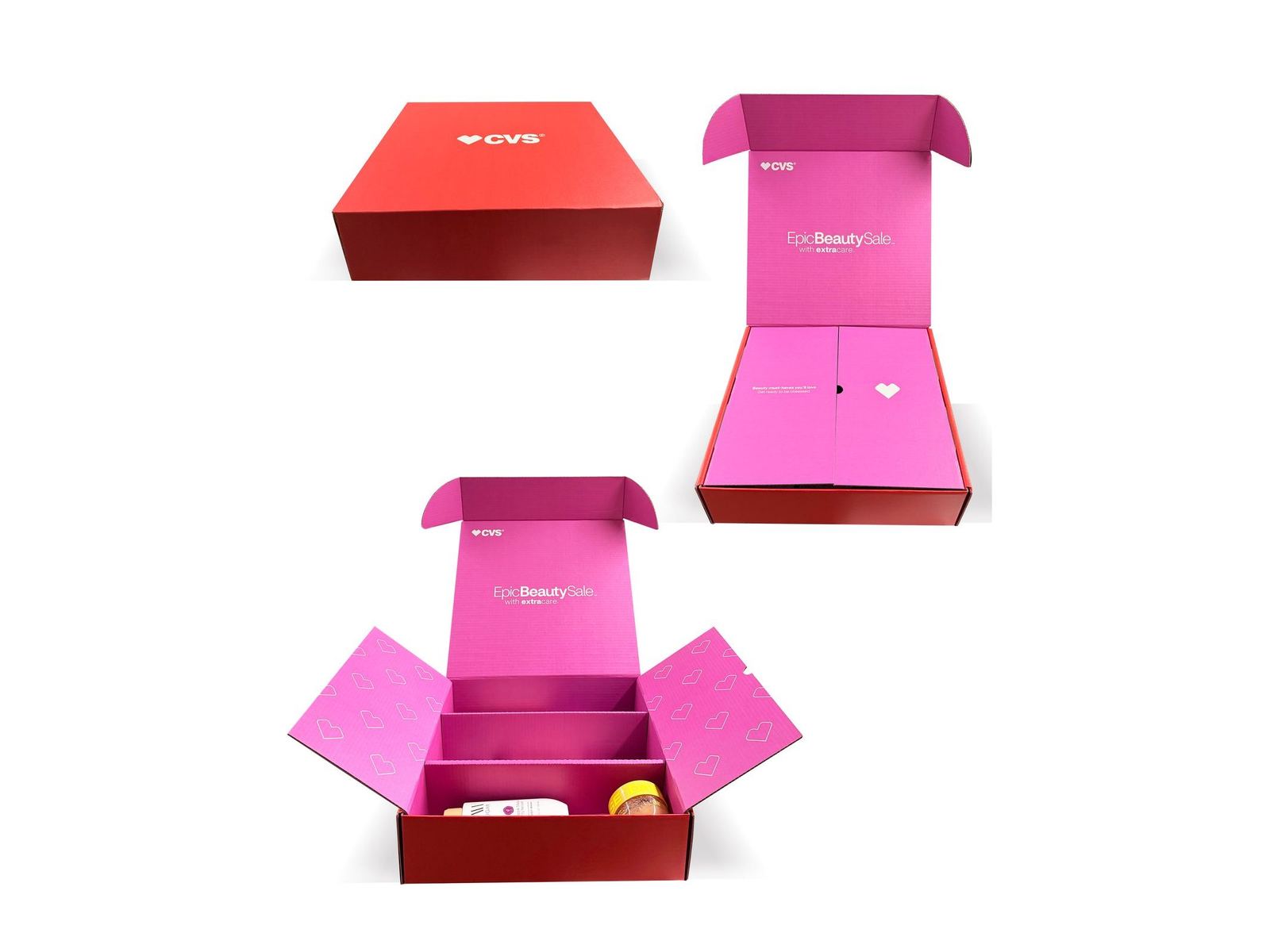
Most direct-to-consumer programs run on two formats. A mailer box — corrugated, tuck-closing, printed inside and out — is the workhorse for anything that fits in a small footprint, and it's where the unboxing moment actually lives, since the interior surface is the first thing the customer sees. That same expertise extends to custom mailer boxes built to hold a specific product rather than a size class.
Larger or heavier orders move to a shipping carton, where the job is protection first and presentation second. For direct-to-door orders, we also produce custom shipping boxes with logo built to survive transit while reinforcing your brand — printed outer boxes that hold their shape through a parcel network and still read as yours on a porch. Brands that run both formats usually print them from the same artwork files, so a small order and a large one arrive looking like the same company sent them.
The most expensive habit in e-commerce packaging is buying close-enough box sizes. A carton a half-inch too generous in every direction needs void fill to stop the product rattling, ships at a higher dimensional weight, and looks careless when it's opened half-empty. Cutting the box to the product removes all three problems in one decision.
Right-sizing is also where a custom program pays for itself against stock boxes. Fewer sizes to inventory, less filler to buy and store, lower dimensional weight per parcel — and a box that presents the product properly the second the flaps come up. We dimension the inner packaging and the outer carton together for the same reason, so a fitted insert and the wall around it are engineered as one part instead of sourced from two vendors and hoped into alignment.
When the sale happens on a screen, the box is the brand's only physical touchpoint — the substitute for a store, a shelf, and a salesperson. That's a design brief, not a decoration budget. Printing on the interior panel, a fitted tray that presents the product upright, a tissue layer or belly band that delays the reveal by one beat: each is a small per-unit cost that changes what the customer sees first.
Finishing carries the rest. Foil stamping, embossing and debossing, spot UV, and matte, gloss, or satin coatings all run to the same spec, so a mailer can carry the same finish language as retail packaging without a second supplier in the chain. The practical test is whether the box still looks deliberate after a courier has handled it — which is a structural question as much as a graphic one.
Sustainability requests arrive in nearly every ecommerce brief now, and in this category they line up neatly with cost. We run recycled and FSC-certified corrugated, produce biodegradable poly mailers, and print with water-based inks on request. Right-sizing does quiet work here too: a box cut to the product uses less board and less void fill than a stock size that almost fits.
Because design, print specification, and finishing all run through one team, a sustainable spec doesn't add a vendor or a shipping leg to the job — it's the same production line running different material inputs. It's custom packaging built for a sustainable brief as much as a shipping one — corrugated boxes from recycled stock, not a special order.
Packaging cost isn't the unit price of a box; it's the unit price plus filler, plus dimensional weight, plus the replacement units and refunds that damage generates. A slightly heavier board that stops a product arriving crushed is usually cheaper than the box it replaced. We quote directly — board, dies, and press time all itemized — so the tradeoffs in a spec are visible rather than buried in a broker's margin. It's what makes an e-commerce packaging program cost out honestly across the whole shipping process, not just the box that shows up.
Reorders are where programs quietly drift. We hold the die and the color proof between runs, so the second and third production runs match the first without re-tooling, whether the order is five hundred mailers or fifty thousand. Low minimum order quantities mean a launching brand can put a real custom box on a first run instead of buying stock cartons and applying a sticker, then scale the same spec as volume grows.
Once a program moves real volume, the parcel box stops being the only packaging decision. Case-level shippers carry units to a fulfillment center, and they need to protect a stacked load, open cleanly on a pack-out line, and hold their count without a worker cutting into product. We build those to the same tolerances as the retail-facing box, sized to the pallet and the shelf they'll live on rather than to a stock case.
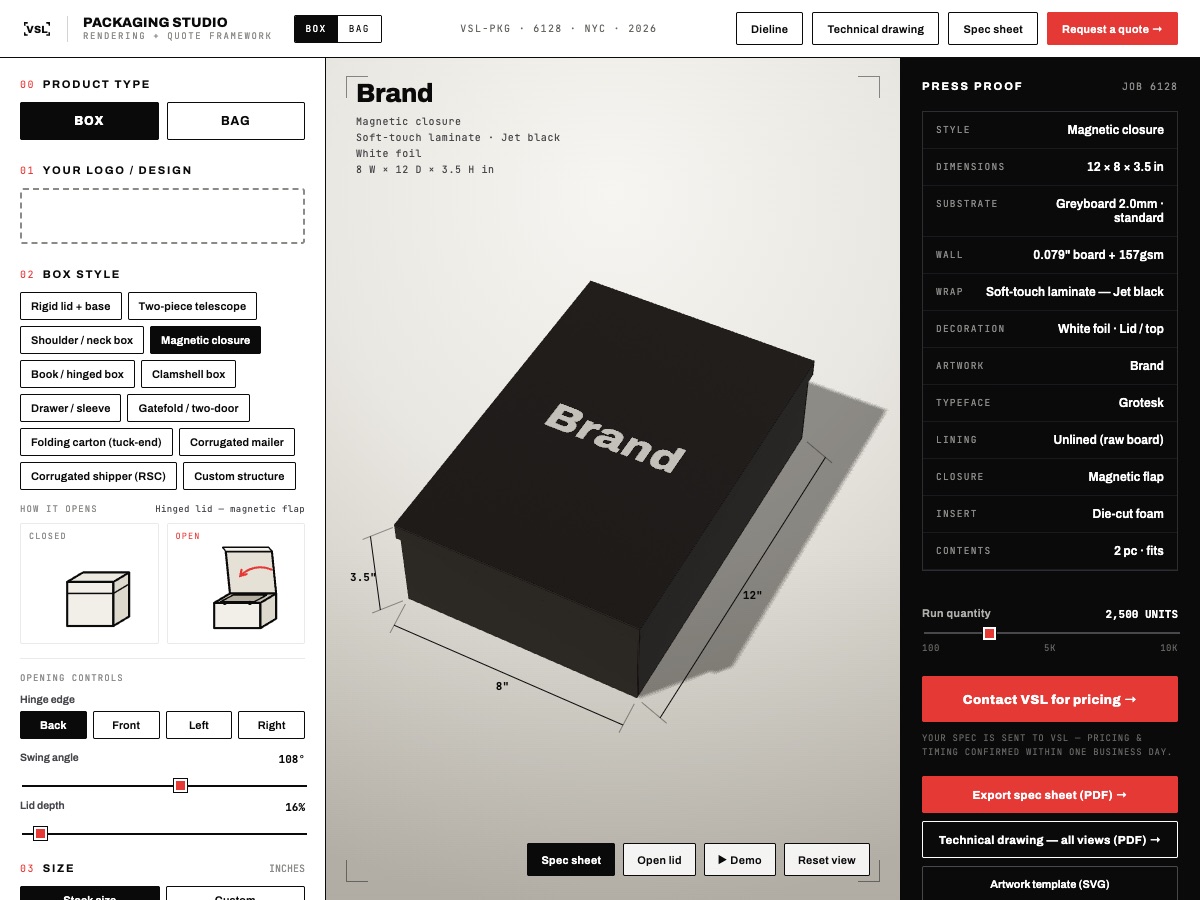
Every e-commerce packaging program here starts with something you can hold. We draw the dieline around your product, build a photorealistic 3D rendering so you can judge color and proportion on screen, then cut a physical prototype you can load, seal, and open. A rendering can't tell you the flap tears when a customer pulls it or that the insert traps the product too tightly — a prototype will, before a full run commits. If you'd rather start hands-on, build the structure in the VSL Packaging Studio and send the spec straight to our engineers.
Can the same box work for retail shelves and ecommerce shipping? Usually not without compromise. A box built to survive parcel shipping tends to be overbuilt for a shelf, and a box built for shelf presence often isn't built for drop and crush. If you sell both channels at volume, it's worth speccing packaging for each and printing them from shared artwork.
Do I need a custom size, or will a stock box do? A stock box works if your products cluster around a few dimensions. When they don't, you pay for the mismatch twice — once in void fill and once in dimensional weight — and the unboxing suffers. Right-sizing usually pays for itself before the branding does.
Can you produce the mailer and the outer shipping carton in one order? Yes, and it's the better way to do it. Producing both under one program lets us dimension the inner and outer packaging together in one prototyping cycle, so nothing shifts in transit — one purchase order, one production run, no coordination between separate vendors.
Considerations
Related Industries
Tell us the product, the channel, and the quantity — we'll map boxes, bags, and mailers to one program.