Industry
Custom jewelry packaging built in New York for fine, bridal, and fashion jewelry brands — structural design, prototyping, print specification, and finishing all managed by one team, so a concept becomes a physical sample in days rather than weeks.
Jewelry packaging carries more weight than packaging for almost any other category — a scuffed corner or a loose-fitting box can undercut a $2,000 piece before a customer even opens it. We build custom jewelry packaging in New York, working directly with fine jewelry, bridal, and fashion jewelry brands as a full custom jewelry box manufacturer: structural design, prototyping, print specification, and finishing all run through one team, so a concept becomes a physical sample in days rather than weeks. That matters most in jewelry, where a millimeter of insert tolerance is the difference between a piece sitting securely and one that rattles in transit.
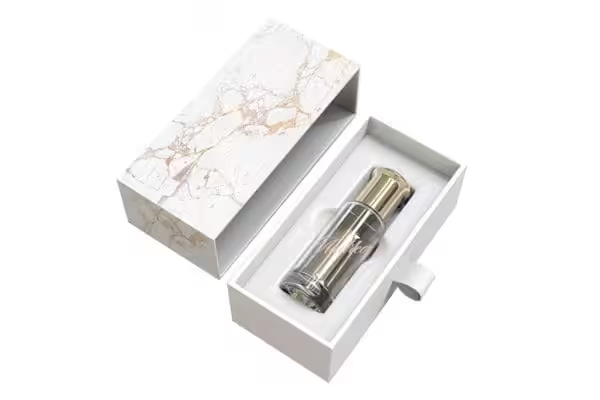
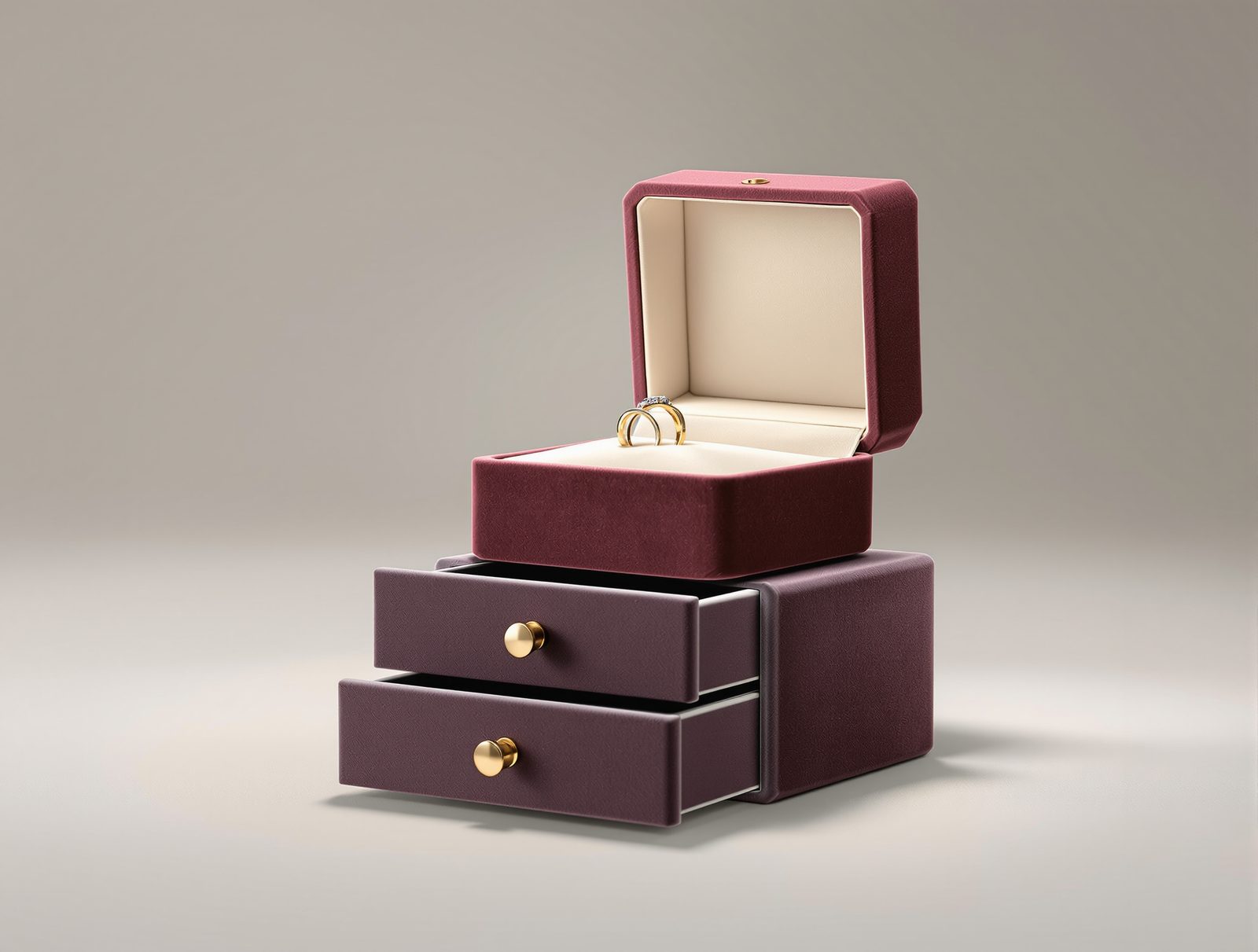
Jewelry buyers register weight and rigidity before they register anything printed on the lid, which is why most fine jewelry lines start with rigid-stock boxes, built from dense chipboard wrapped in printed or textured stock so a ring or pendant box feels substantial the moment it's picked up. Rings, studs, and single pendants often move into our custom shoulder boxes, where a fitted lid nests over a lower tray for a two-part reveal that reads as more deliberate than a simple flip-top lid. For jewelry sets, matched pairs, or bridal collections sold as two boxes together, we build telescopic boxes, where a full lid lifts cleanly off a deeper base instead of hinging — a construction that also holds up better to repeated opening on a retail counter. Bridal collections in particular tend to buy in twos — engagement ring today, wedding band later — which is exactly the pairing a two-box telescope set is built for.
None of those formats matter without an interior built for the exact piece going inside. We cut foam and paperboard inserts to the outline of a specific ring, chain length, or bracelet, so nothing shifts or scratches during shipping. Velvet and suede-textured linings do double duty — they cushion metal and stones against abrasion while giving the box a tactile, high-end feel the moment the lid comes off. For brands running several SKUs through one box style, we build universal cavities that flex across ring sizes or chain lengths without a full re-tool for every product, which keeps unit costs sane at low-to-mid production volumes. Most of the real work in creating a jewelry box happens here, at the insert stage, well before foil or print ever get discussed.
A ring box, an earring box, and a necklace box all solve different problems even when they're built from the same rigid or shoulder-box platform. Ring boxes are mostly about the insert — a slot or a foam channel that holds one ring steady in a box small enough to fit a palm. Earrings need two secure points instead of one, so we design the insert for the pair rather than a single slot, and pack studs and drops differently since drops need more clearance. Necklace boxes are a different design problem entirely: the box has to be long enough or deep enough for a chain to lie flat without tangling, and a necklace box that's just a scaled-up ring box usually gets that wrong. We build all three jewelry boxes off the same rigid, shoulder, and telescope construction so a brand's whole jewelry collection can share one jewelry packaging language on the shelf.
Most jewelry growth now happens direct-to-consumer, and the unboxing moment is standing in for the in-store experience a DTC brand doesn't get. Foil-stamped logos, soft-touch coatings, and embossed brand marks on custom jewelry boxes signal the price point before a customer even lifts the lid, and that first impression is what gets photographed and shared. We also build jewelry gift packaging around that same moment — ribbon closures, magnetic lids, and printed tissue or dust bags that let a customer ship a piece as a finished gift without wrapping paper. It's the detail a customer notices after the purchase is made — a box worth keeping instead of one that gets thrown out with the mailer, which is easy to underrate until you see how many customers save it for a second use or share it online.
Wholesale and boutique accounts need packaging that performs differently than a shipped box — it has to survive being opened and closed by staff dozens of times a day and still look new at the end of the week. We build reinforced corners and tamper-evident closures into pieces headed for open retail display, along with presentation trays and counter-ready cases sized to a store's existing fixtures. A consistent logo placement across every format — box, tray, and case — is part of what makes a wholesale line read as one brand instead of three, whether it's selling in the fine jewelry category or the fashion jewelry category. Because prototyping happens in-house, we can mock up custom rigid boxes or counter displays in a day or two, so a wholesale account can approve a physical sample before a full production run ships.
Low minimum order quantities mean an independent jewelry brand isn't forced into a warehouse-filling first run just to get branded jewelry boxes, and production scales as the order grows and the line moves into new retail accounts. In-house 3D rendering and prototyping, plus a full finishing program — debossing, foil stamping, spot UV — mean a structural change or a new foil color doesn't cost a six-week reorder cycle. That combination of speed, low MOQs, and real prototyping is what lets us support a jewelry brand from its first drop through a full wholesale rollout, building custom jewelry boxes and jewelry packaging that scale with it.
What's the difference between rigid, shoulder, and telescope jewelry boxes? Rigid boxes are a single sturdy structure built for weight and shelf presence. Shoulder boxes use a fitted lid over a lower tray for a two-part reveal. Telescope boxes use a full separate lid that lifts entirely off a deeper base — a good fit for sets or pieces that get opened repeatedly on a retail counter.
Can you match foam or velvet inserts to a specific ring or chain size? Yes. We cut inserts to the exact outline of the piece, and for brands running multiple sizes through one box, we can build a universal cavity that flexes across a size range without a separate tool for every SKU.
Do you offer low minimum order quantities for jewelry brands? Yes. Our minimums are built for independent and early-stage jewelry brands, and production scales up as a line grows into wholesale or subscription volume without changing suppliers.
Considerations
Tell us the product, the channel, and the quantity — we'll map boxes, bags, and mailers to one program.