
Boxes
Custom Telescopic Boxes
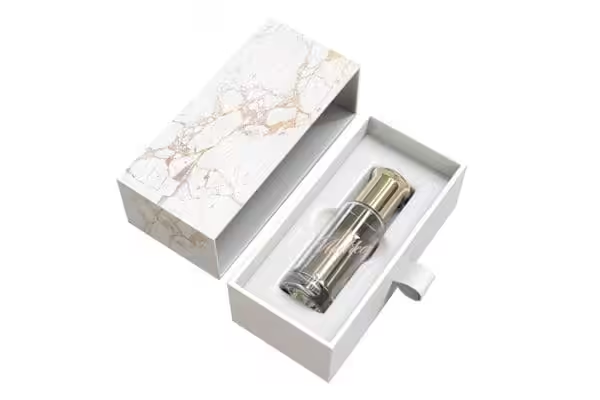
A two-piece package where a lid slides down over a base on a snug friction fit — no glue, no tuck flaps. Built in New York City, from a single prototype to a full production run.
Construction
Two piece; lid slides down over the base
Coverage
Full telescope or partial (half) telescope
Lid Depth
Shallow slip lid through to a deep, crush-resistant lid
Printing
Lid and base printed as two separate panels
A telescopic box is a two-piece package where a lid slides down over a base, the way a pull-off cap fits over a pen — no glue, no tuck flaps, just a snug friction fit between two shells. Most buyers just call these telescoping boxes, and we build them sized to the product rather than to a stock chart. It's one of the oldest rigid-box constructions still in regular production because a lid that comes fully off and sits flush against the base still reads as a single clean object once it's closed. We build custom telescope boxes in New York City, from a single prototype to a full production run, and it's the format we reach for most when a client needs telescope packaging that looks considered on a shelf and survives a shipping dock on the way there.
Full vs. Partial Telescope Construction
The base decision on any telescopic box is how much of the base the lid covers. A full telescope box has a lid deep enough to reach the bottom edge, enclosing the base completely — no bare board showing on any side. It's the more protective option, and the one most gift and retail brands default to, since the lid does double duty as both closure and outer graphic surface.
Partial (or half) telescope construction stops the lid short, typically covering a third to two-thirds of the base height and leaving a strip of the base panel exposed. That band isn't just a cost-saver on board, though it is one — it's a natural spot for a second color or a printed base pattern that only reveals itself once the lid is on, and it uses less material per unit on high-volume runs — a sizing choice we make with you once we know the price target and the outer box dimensions.
Lid-Depth Options
Beyond full versus partial, lid depth is its own variable. A shallow lid — often called a slip lid — covers an inch or two of the base and functions mostly as a dust cover, common on board games and other flat, rigid contents that don't need side support. A deep lid extends several inches down the base wall, adding crush resistance so the box does more of the protective work on its own, without relying entirely on foam underneath. That's real protection for products shipped loose inside an outer box, not just a cosmetic lid. We spec lid depth against the product's own rigidity: heavier, self-supporting items can run shallow; fragile or loosely packed ones get pushed toward a deeper lid — true of full and partial construction alike.
Where Telescope Boxes Fit: Garments, Gifts & Board Games
Our studio sits in the middle of Manhattan's Garment District, so apparel packaging is a natural lane for us — folded shirts and knitwear suit a telescopic box because the lid lifts straight off without disturbing how the product is folded inside. That same lift-off mechanic is why telescope boxes carry so much of the gift packaging category: a customer opens the box the way they'd open a gift, not the way they'd tear into a shipping carton. Board games are a quieter but consistent third use case — a shallow-lid telescope box holds a board, cards, and pieces without internal flaps crowding the components, and the flat lid gives a full graphic panel for cover art. For heavier contents we build the base and lid from double-wall board instead of single wall, the same grading logic we use on shipping boxes built for transit rather than a shelf.
Telescope vs. Shoulder and Rigid Box Formats
Telescope construction gets compared most often to two other rigid styles. Shoulder boxes use similar base-and-lid logic, but the base includes a raised inner shoulder the lid rests on rather than covers, so part of the base wall stays visible even at a "full" close — useful when the base and lid need to read as two distinct printed surfaces. Fixed one-piece rigid boxes don't separate into two components at all; they open on a hinge or magnetic flap, trading the lift-off of a telescopic box for a lower part count and a closure that can't be misaligned during assembly. None of the three is strictly better — it's a question of how the box needs to open, what size fits the product, and what custom printing the launch calls for.
Printing on the Lid and Base
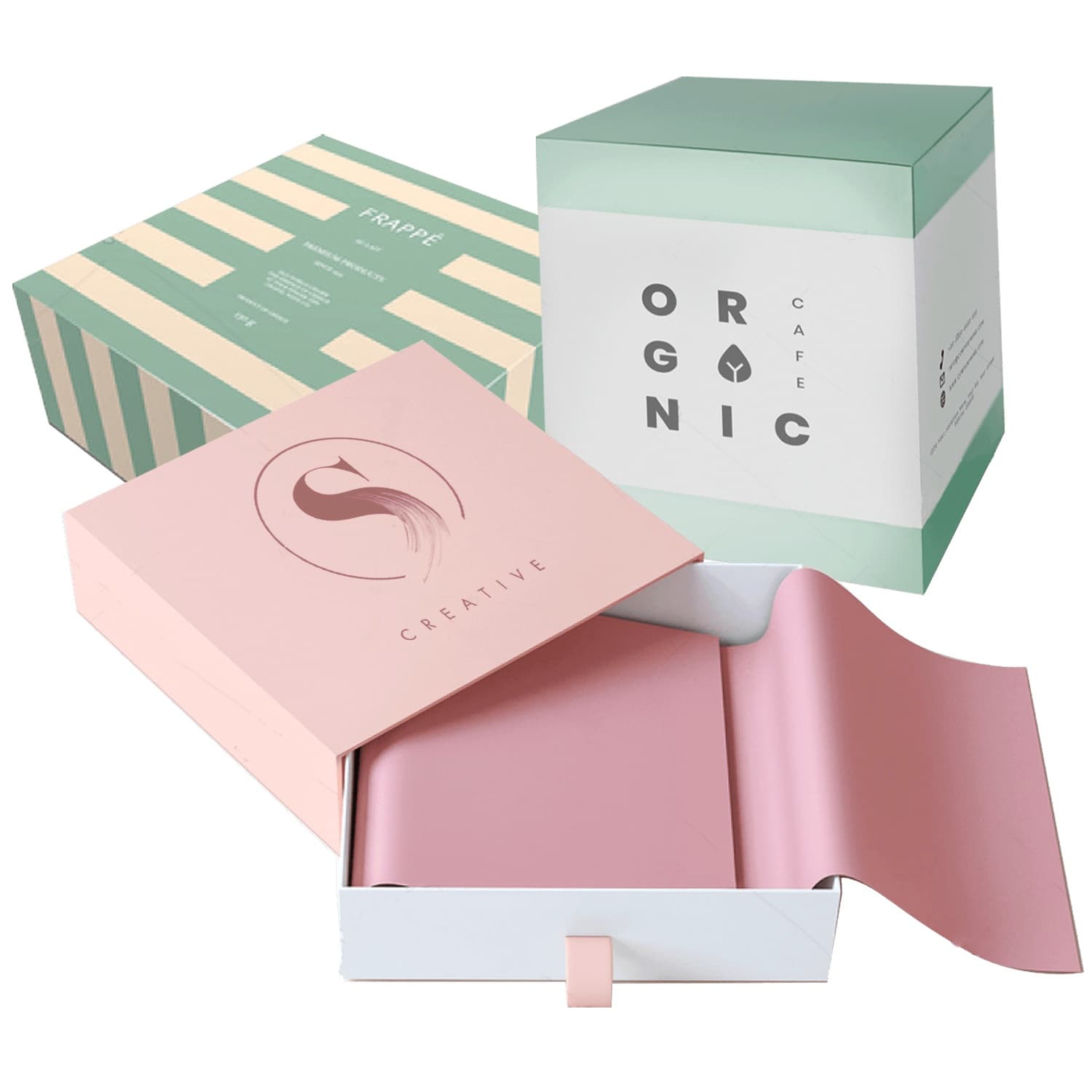
Because a telescopic box splits into two independent panels, printing has to be planned as two coordinated jobs rather than one continuous wrap. The lid is the surface a customer sees first, so it usually carries the primary logo or hero graphic; the base can either match the lid's palette for a seamless closed look, or run a contrasting graphic that only shows on partial-telescope builds where a strip of base stays exposed. Registration matters more here than on a one-piece carton — if the lid graphic is meant to align with a base pattern, both dies need to be proofed together, not separately. Our finishing options — foil, embossing, spot coatings — apply to either panel, so a debossed lid paired with a matte base isn't a special request, just a normal spec. Custom printing like this is what makes a telescoping box feel engineered rather than assembled from stock parts.
Get a Quote on Custom Telescopic Boxes
Whether you need a single full telescope box for a launch or a wholesale run of custom telescopic boxes sized to a garment or gift set, we prototype and produce the whole job as one team. Send us your product dimensions and we'll spec lid depth, construction type, and print layout before a die is cut.
Telescope Box FAQ
What's the difference between a full and a partial telescope box? A full telescope box has a lid that reaches the bottom of the base, enclosing it completely. A partial (or half) telescope box uses a shorter lid that covers only part of the base height, leaving a printed or contrasting band of the base visible.
How do I pick a lid depth for a telescope box? Lid depth follows the product's own rigidity. Rigid, self-supporting contents like board games usually suit a shallow lid; fragile or loosely packed items do better under a deeper lid that adds crush resistance along the base wall.
Can you print separate designs on the lid and the base of a telescopic box? Yes. The lid and base are printed as two separate panels, so each can carry its own graphic, color, or finish. We proof both together beforehand so any pattern meant to align across the two pieces registers correctly once the box is closed.
Are telescoping boxes available in double-wall or single-wall board? Yes — lighter single-wall board keeps cost down for gift and apparel telescoping boxes, while double-wall board adds crush resistance for heavier telescoping boxes that double as shipping boxes in transit.
Constructions & Use Cases
Ways We Build This Format
Price Your Run
Product dimensions, quantity, and any finish ideas — we will quote structure, material, and print.