Industries
Different products break packaging in different ways. Beauty brands care about presentation, electronics need crush resistance, food packaging has its own set of rules, and regulated categories need panels and closures that hold up under scrutiny — these pages show how we adapt structure, packaging materials, and finishing to the category in front of us.
Browse by Vertical
Materials & Capabilities
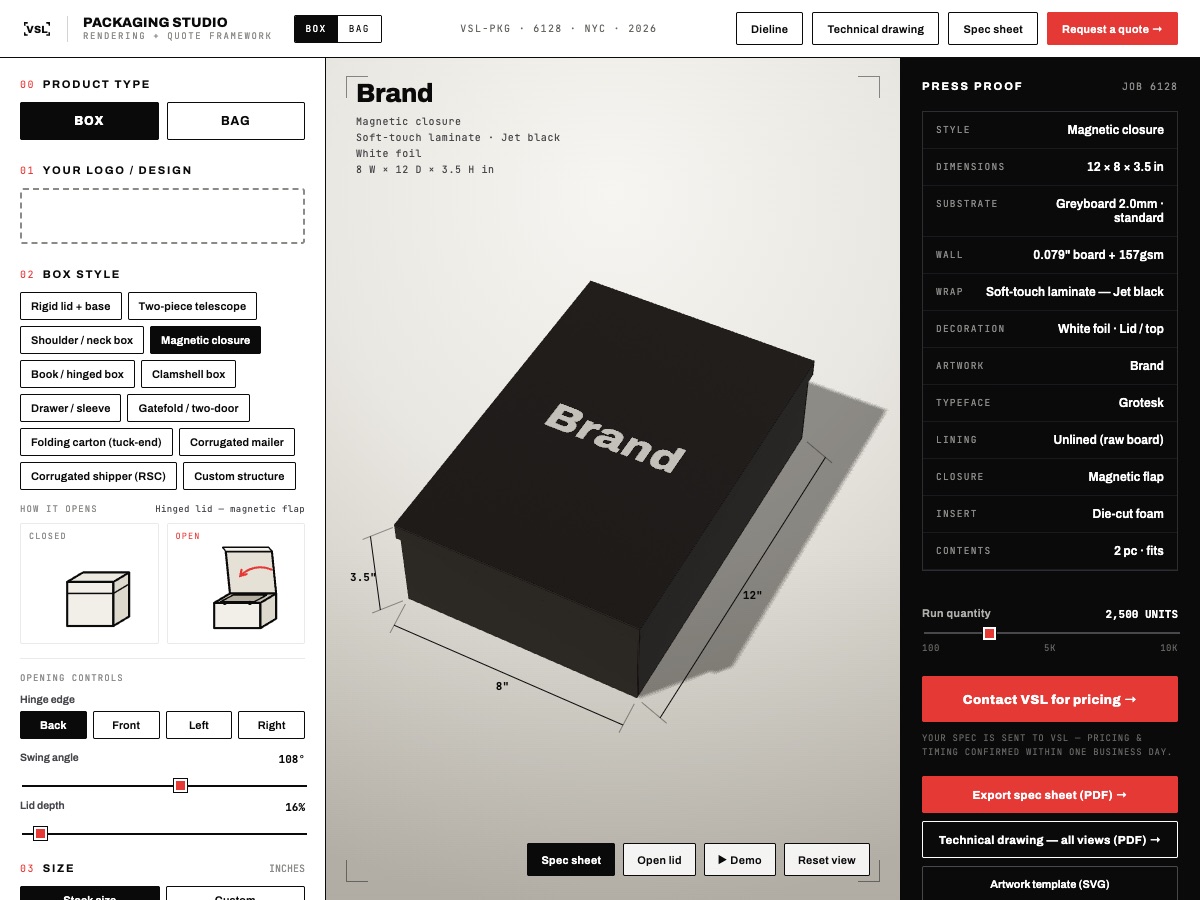
What changes between categories is the spec, not the process. Every program on this page runs through the same end-to-end pipeline: structural design, 3D rendering, prototypes, and proofs before anything reaches production.
What changes is the brief. A consumer packaging program headed for a retail planogram gets specified differently than an e-commerce mailer that has to survive a parcel network, and a food packaging job carries requirements neither of the other two do. Where a category asks for sustainable packaging, we work it into the substrate and the structure — recyclable board, right-sized boxes that cut void fill — rather than into the marketing copy, because that is the part of the packaging industry a buyer can actually verify.
Board & Stock
Packaging by industry is not a marketing frame — it is how the work actually arrives. A beauty brand and an electronics brand can order the same box style and still need two different structures, because what the packaging has to survive, say, and prove differs by category. The pages above exist so you can start from the constraints your industry already carries, with examples of custom packaging built for those constraints, instead of translating a generic catalog into your world. The sections below explain how we adapt structure, materials, and finishing to the category in front of us — and what stays the same no matter what you sell.
Every vertical carries requirements that show up in the dieline long before they show up on a press. Cosmetics and beauty packaging lives or dies on presentation — rigid board, tight-fitting lids, and finishing that reads premium in the hand. Electronics need static-safe inserts and crush performance measured against the weight of what ships inside. Food programs answer to grease and moisture barriers, and footwear packaging has to hold a heavy product through a stockroom and a return cycle without losing its shape. When we quote an industry program, those constraints arrive first: the material spec, the closure, the insert geometry, and the finishing budget are all answers to what the category demands, not a template with new artwork. That is also why the industry pages above lead with format recommendations — the structures each category orders most, learned from production runs rather than a chart.
Some categories add a second layer of requirements on top of the physical ones: panel real estate that regulation spells out. CBD packaging rewrites its labeling rules often enough that fast turnaround on panel changes is part of the spec. Medical and pharmaceutical packaging programs need lot and expiry real estate, tamper evidence, and structures sized to the primary container the product already ships in. Supplements and nutraceutical packaging sit between the two — retail-facing presentation that still has to pass a compliance audit. We plan the required panels into the dieline from the start, so the legal copy has a home before the design is approved and nothing gets shrunk to fit at the proof stage.
The same product often needs two packaging answers. On a shelf, the box is a salesperson: retail packaging is sized to the planogram, printed for the three feet a shopper stands from it, and structured to survive restocking. In a parcel network, the box is a shipping container first — e-commerce packaging absorbs drops and compression, opens into an unboxing moment, and often has to do it without an outer carton. Luxury programs push both at once: presentation that justifies the price, protection that survives the courier. Because we build for both worlds, an industry program here usually pairs formats — a retail unit and a shipper, a gift box and a mailer — engineered as one family so the brand reads the same wherever the customer meets it.
Material choice is where industry requirements and budget meet. Corrugated does the heavy work — shippers, trays, and anything that rides a parcel network — while folding carton stock covers retail units and rigid board carries the premium end. Which grade a category needs is a production question, not a taste question: a home-goods shipper is specified against the weight of what is inside it, a jewelry packaging program against the presentation moment, a food carton against grease and moisture. Sustainability now runs through every one of those conversations: recycled and FSC-certified stocks are standard options rather than a premium tier, and categories with visible eco commitments — apparel, beauty, e-commerce — increasingly spec them by default. Cost follows the same logic. The biggest price levers in any category are size, board grade, print coverage, and finishing, in that order, and an industry program that trims an inch from a dieline usually saves more than one that trims a color from the artwork. We put those tradeoffs on the table at the quote stage, priced against your quantity, so the material conversation happens before tooling — not after a run disappoints.
What does not change between industries is the pipeline. Every program on this page moves through the same end-to-end sequence — structural design, a photorealistic render, a physical prototype, a press proof, then production — managed by one team in New York City. That matters for categories with tight timelines, because a revision moves to the next sample in days, and it matters for brands that span categories: the team that built your retail carton already knows your color standards when the e-commerce mailer comes up. If your category is not listed above, that is not a wall — about a third of our work starts as a product that does not fit a named vertical. Request a quote with the product and where it sells, and we will scope the structure against the constraints that actually apply.
Tell us the product, the retail context, and the quantity — we'll recommend the structure, the packaging materials, and the finish.
Common Questions
Twenty-two verticals are covered on this page, from apparel and beauty through food packaging, CBD, medical, and industrial programs. Those are the categories where packaging requirements diverge most — materials, closures, compliance panels, and retail presentation. The pipeline behind them does not change from one industry to the next.