

education guide
Corrugated Box 101: Types of Corrugated Boxes Explained
A plain-English guide to corrugated box types: flute profiles, ECT vs. Mullen board grades, and box styles like RSC, HSC, and FOL — from our NYC packaging shop.
Corrugated boxes are classified along three independent specs: flute profile (the fluting size between the liners), board grade (the strength rating, expressed as ECT or Mullen), and box style (the flap-and-fold construction, like RSC, HSC, or FOL). A single box is really a combination of all three — a C-flute, 32-ECT regular slotted container is a different box than an E-flute, 200-Mullen die-cut mailer, even though both are "corrugated." Once you can read those three specs, choosing the right type of corrugated box stops being guesswork. Whether you call it a corrugated box or corrugated cardboard, the same three specs apply.
What Is Corrugated Packaging?
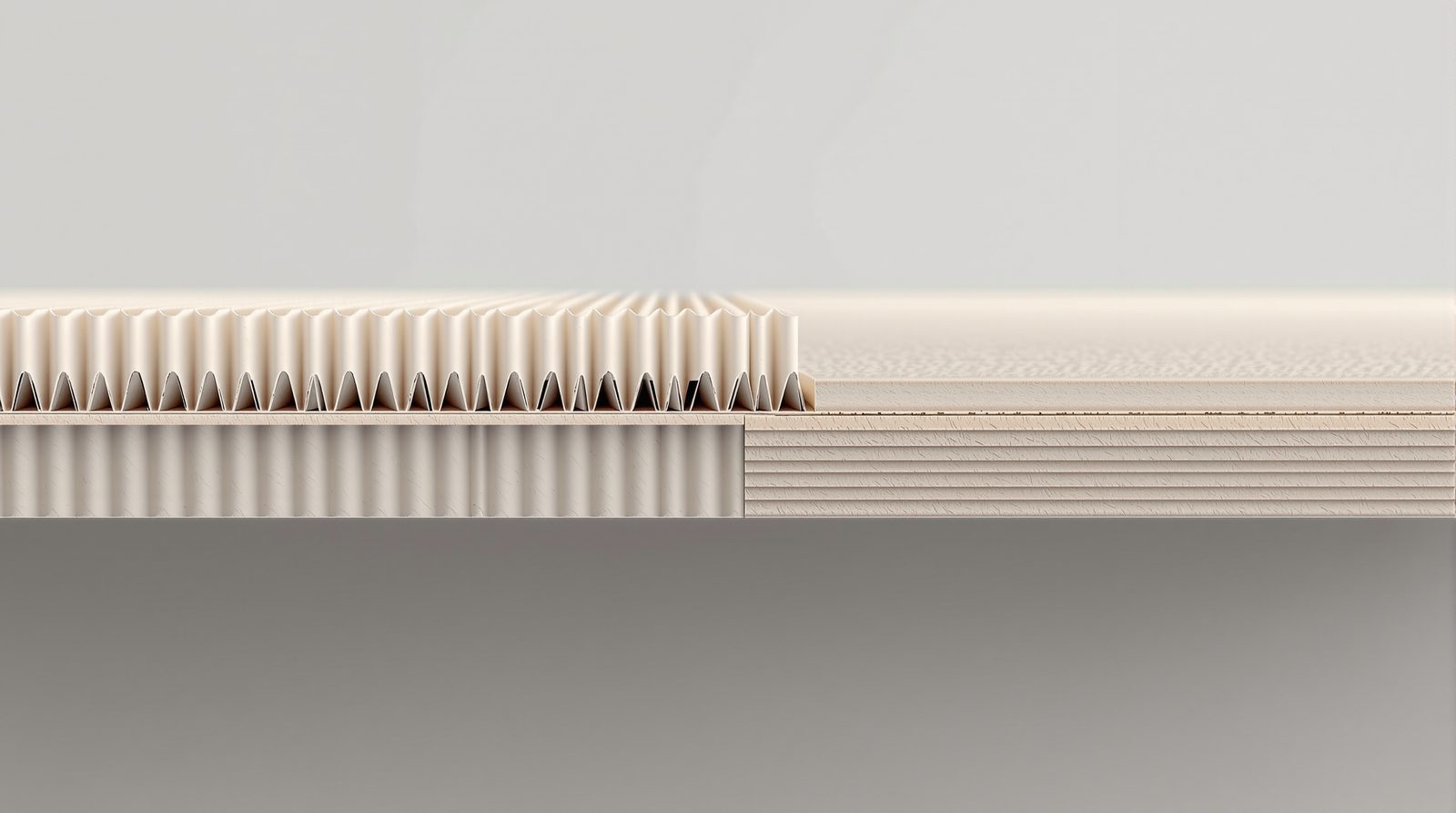
Corrugated packaging is board made from three layers: two flat liner sheets glued to a wavy fluted medium sandwiched between them. That fluted layer is what separates corrugated from single-ply paperboard — it traps air, resists crushing, and adds rigidity and structural strength without adding much weight. Nearly every shipping case, most retail cartons, and a lot of point-of-sale packaging start as one of the corrugated grades below. The differences come down to how thick the flute is, how strong the board tests, and how the box is cut and folded. Corrugated cardboard and corrugated board are the same material by two different names — cardboard is the everyday term, board is the spec-sheet term — and the end result gets called corrugated cardboard boxes regardless of which style or flute is underneath.
Flute Types: A, B, C, E, and F Flute (Plus Doublewall)
Flute size drives cushioning, crush resistance, and print quality, and it's usually the first spec we settle on a new prototype:
- A-flute (~4.7mm) — the thickest common flute, with the best cushioning and stacking strength; used where impact protection matters more than a compact profile.
- B-flute (~2.5mm) — a firmer, smoother surface that takes flexographic and litho printing well; common in retail-facing cartons and point-of-sale displays.
- C-flute (~3.6mm) — the default for general shipping, splitting the difference between A and B on strength and printability. Most standard shipping cases run C-flute.
- E-flute (~1.5mm) — thin enough for detailed print work and folding-carton-style folds, popular for retail shelf boxes that still need corrugated durability.
- F-flute (~0.8mm) — the thinnest common profile, used for small, delicate items and micro-flute retail packaging where wall thickness has to stay minimal.
- Doublewall — two fluted layers and three liners (commonly a BC or AC combination) for heavy, fragile, or long-haul freight that outgrows a single-wall box.
We specify the full range and match flute to load weight and fragility before a dieline goes to press.
Board Grades and Strength Tests: ECT vs. Mullen
Flute tells you the profile; board grade tells you how much weight and stacking pressure the box survives, and that's measured one of two ways.
Edge Crush Test (ECT) measures how much force a board withstands before it crushes standing on its edge — the number that predicts how a box performs stacked on a pallet. A 32-ECT board is standard for most shipping cases; heavier or export loads often step up to 44-ECT or higher.
Mullen Burst Test measures how much pressure it takes to puncture the board — a better predictor for boxes handled roughly or struck with a sharp edge rather than stacked flat. Mullen ratings (like 200-lb test) still show up on carrier-mandated specs and for irregular, non-stacked loads.
Most carriers now accept either rating if it's certified, but the right one depends on how the box actually gets loaded and shipped: palletized and stacked favors ECT, handled and tossed favors Mullen.
Corrugated Box Styles: RSC, HSC, FOL, and Die-Cut
Once flute and board are set, the last variable is how the box is cut and folded:
- Regular slotted containers (RSC) — the standard box built with four flaps on the top panel and four flaps on the bottom panel, meeting edge to edge when folded and taped for a fully sealed six-sided case. It's the format behind most e-commerce shipping and wholesale distribution; see our full breakdown of RSC boxes for construction detail and sizing.
- Half slotted containers (HSC) — a full bottom panel with flaps on one end only, left open for a cap, pallet wrap, or oversized load. We cover sizing and common use cases on the half slotted containers page.
- Full overlap slotted containers (FOL) — flaps that extend the full width of the box rather than meeting edge-to-edge, doubling up material across the top panel and bottom panel for extra stacking strength on heavy or irregular loads.
- Die-cut boxes — custom-shaped blanks cut on a rotary or flatbed die instead of assembled from standard slots and flaps, used for mailers, retail-ready cartons, and anything needing a non-standard fold pattern or built-in features like handles or windows.
All four styles start from the same corrugated cardboard stock — the style is a cutting-and-folding decision layered on top of the flute and board grade you've already chosen.
Which Type of Corrugated Box Should You Choose?
There are several types of corrugated box to choose from, and matching the spec to the job matters more than picking a favorite style. A uniform product shipping direct to consumers is almost always a C-flute RSC at 32-ECT — efficient, automatable, and durable enough for standard parcel handling — the same logic behind most stock shipping boxes. Bulky or palletized freight fits better in an HSC or a doublewall full overlap slotted container (FOL), where crush resistance under stacked weight matters more than a folded closure. Retail-facing product that needs sharp branding leans toward B-flute or E-flute with die-cut construction, since a tighter flute takes print detail a standard C-flute case can't match. If you're not sure which combination fits, that's exactly the kind of question a prototype answers faster than a spec sheet — we build test units in-house before committing a design to a production run.
Corrugated Box 101 FAQ
What is corrugated packaging made of? Corrugated packaging is three layers of paperboard: two flat liner sheets glued to a wavy fluted medium in between. The flute layer is what gives corrugated board its cushioning and crush resistance compared to flat paperboard.
What are the main types of corrugated boxes? The main types of cardboard boxes break down by flap style — regular slotted containers (RSC), half slotted containers (HSC), full overlap containers (FOL), and die-cut boxes — combined with a flute profile (A through F) and a board strength rating (ECT or Mullen).
Which corrugated box type is strongest? Strength depends on what's being measured. A-flute and doublewall board give the best cushioning and stacking strength, while a higher ECT or Mullen rating means a stronger board regardless of flute. B-flute trades some of that cushioning for a smoother, more printable surface, which is why it shows up more on retail-facing cartons than on heavy freight. For heavy or long-haul freight, a doublewall FOL with a high ECT rating is typically the strongest standard combination.