
Wine and specialty food retail put different demands on a shopping bag than general retail does. Bottles are heavy, fragile, and expensive enough that a handle failure or a base that folds under weight isn't a minor inconvenience — it's a broken bottle and a customer who doesn't come back. This page looks at what actually changes when a shopping bag has to carry wine and gourmet products rather than just wrap a purchase — structure, sizing, stock, and finish are the sections that matter most on this page, in that order.
Wine Bags Have to Solve a Structural Problem First
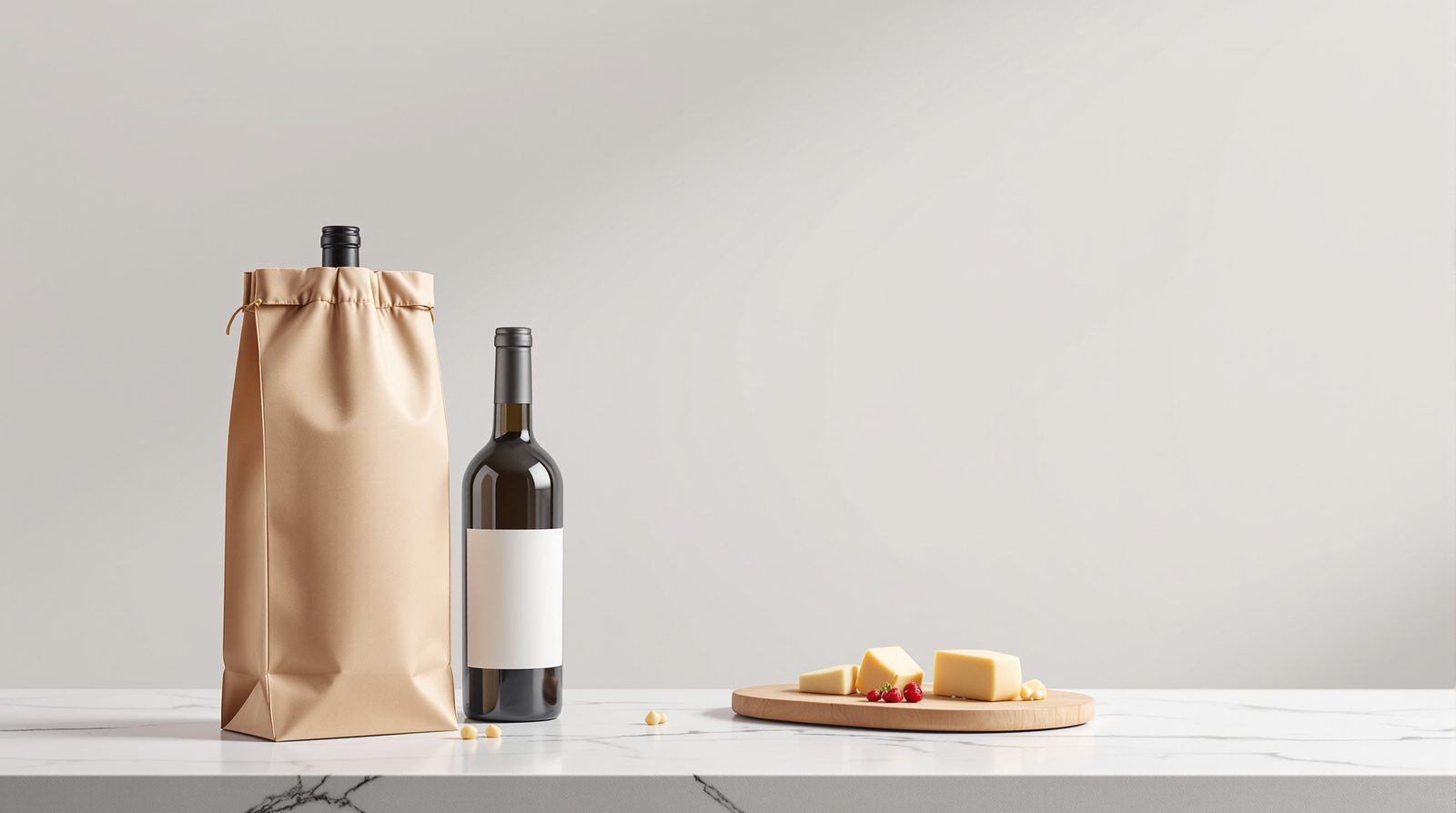
A folded sweater forgives a weak gusset. A bottle does not. Wine bags need a base built to hold real weight without buckling, a gusset deep enough to keep the bottle upright instead of tipping against the side panel, and a handle reinforced at the attachment point, since that's where a heavy, rigid load concentrates all its stress. Rope and twisted-paper handles threaded through reinforced eyelets carry glass better than a die-cut handle ever will, because the load spreads across the whole hand instead of biting into a narrow strip of stock.
Stock choice follows from the same physics. Kraft paper is the efficient, everyday option and holds a single bottle without complaint, but a coated or laminated stock resists the condensation an ice-cold bottle sweats onto the bag, which plain paper does not handle well over a real carry. For a bag that's meant to be reused — a wine tote a customer keeps in the car or the kitchen — the heavier stock earns its cost quickly; for a single-bottle gift bag used once, kraft is usually the right call.
We build a physical prototype in your actual stock before any wine bag goes to production, and we test it the way a customer will actually use it — loaded with real bottles, carried, set down, picked back up. A bag that looks right on a screen can still fail at the handle the first time it carries real glass, which is exactly why we don't skip that step.
Sizing Wine Totes for a Single Bottle Through a Full Case
Wine totes cover a wider size range than most retailers plan for. A single-bottle bag for a gift purchase is a different structure than a bulk carrier meant to hold most of a case, and the two shouldn't share a spec just because both are labeled "wine bag." Between them sits the everyday two-bottle and four-bottle format most wine shops actually sell the most of.
Dividers or a reinforced interior insert keep multiple bottles from knocking against each other in transit, which matters whether the customer is carrying a single regional favorite home for dinner or a mixed selection across several regions for a party. Select the size and interior structure around what you actually sell most, the same way you would for any other shopping bag — and size up separately for the gift and case-quantity purchases that don't fit the everyday format. The stock section further down this page covers the material side of that same decision.
Pricing a bag run?
Get structure, stock, and finish quoted from your real quantities.
Finish and Branding for Specialty Food and Wine Retailers
Finish is where a wine bag or specialty food bag stops being a carrier and starts reading as part of the purchase. Foil stamping on a label-adjacent mark, embossing or debossing for a tactile logo, and a matte or gloss lamination all read as considered rather than default — appropriate for products where the customer has already paid a premium and expects the packaging to match it.
The same finishing options that work on a wine tote carry over to the products sitting next to the register: cheese, charcuterie, and other specialty food items benefit from the same attention to stock weight and closure, so the whole storefront's shopping bags read as one program instead of a mismatched set.
Beyond the Register: Picnic, Travel, and Gift Occasions
A lot of wine lovers reach for a tote well after checkout — packed for a picnic, carried on travel, or handed over as a gift on its own. A reusable wine tote built for that second life needs the same structural priorities as the one used at the register: a base and handle that hold up to real bottle weight, not just a look that photographs well once.
Gift and picnic purchases are also where restraint pays off. A tote someone is willing to carry again, on a trip that has nothing to do with your store, works better with a mark that reads clearly at a distance than with dense branding that only makes sense at the point of sale.
Specialty Food Packaging Alongside Wine
Most wine retailers also carry specialty food products — cheese, charcuterie, chocolate, and other gourmet items that bring their own packaging requirements around oils, moisture, and shelf presentation. Ask us about food packaging to round out your lineup alongside the wine tote program, so both product categories are specified with the same care rather than the food side getting whatever stock is left over.
Ordering and Testing Before a Full Run
Order quantity for a wine or specialty food bag program should follow the same sequence as any other custom shopping bag: fix the structure and size range first, test a physical prototype with real bottles or product, and then commit to print. We offer both digital printing for a short or seasonal order and screen printing once volume justifies the plates, so the print method can match the order rather than the other way around. Once a die is cut for your structure, you keep the right to reorder against it without paying for new tooling each time, which keeps a repeat order faster and simpler than the first one — and that relationship continues past the first order, since the same dieline is there whenever you need it again.
If your selection changes with the season or the region you're sourcing from, the bag program can change with it — a new colorway or finish on the same proven structure, rather than starting the engineering over each time your inventory turns over.
Talk to Us About Your Wine and Specialty Food Bags
VSL Packaging has built packaging for beverage brands including Belvedere, alongside wine and specialty food retailers sizing their first bag program. Explore our shopping bags page or search the rest of our website for related formats, then tell us what you carry, the bottle count and weight, and how your customers actually use the bag — at the register, on the go, or as a gift — and we'll spec wine bags and totes against those answers for you.
Reach the team at sales@vslpackaging.com or (646) 843-0800 to start a prototype.
Related Shopping Bag Articles
More packaging resources: How Does Branding Influence the Packing of a Product? · How To Get A Food Product Packaged?