
These custom shopping bags case studies are worth reading for exactly one thing: the decisions behind the bag. Structure, handle, stock, and finish are all choices someone made on purpose, and those choices are legible in the finished piece long after the campaign that paid for it has ended. The bags discussed here were designed in Manhattan and produced in New York, and they appear in our portfolio — read them as construction decisions rather than as marketing results.
That distinction matters more than it might sound. Plenty of packaging case studies open with a revenue number and imply the bag caused it. Retail does not work that way, and neither do we.
What a Custom Shopping Bag Case Study Can Honestly Show
A bag never operates alone. It arrives at the end of a transaction that also involved a product, a price, a storefront, a season, and a salesperson. Isolating the bag's contribution to any of that would require a controlled experiment nobody in retail is running.
What a case study can show you is the bag design spec: why one brand chose a rope handle over a twisted paper one, why another accepted the cost of a laminate, why a third shrank its logo to almost nothing. Those decisions transfer to any retail brand weighing the same options. A revenue figure from someone else's fourth quarter does not.
So the sections below describe what was built and why that construction makes sense. If a bag in your category faces the same load, the same shelf, and the same customers, the same reasoning is likely to hold.
Rope-Handle and Cord-Handle Bag Programs
Rope and cord handles sit at the top of the handle range — threaded through reinforced eyelets rather than glued to the inside of the cuff — and three of the programs below are built on them.
One Structure, Two Colorways: Charlie Fox
Charlie Fox runs rope-handle shopping bags printed in two colorways. The useful decision there is the one that stays fixed: a single structure, a single die, a single handle spec, with the artwork carrying the variation. That approach keeps tooling costs on one line item instead of two, lets a second colorway launch without re-engineering the bag, and produces a set that reads as a brand family on the counter rather than as two unrelated bags.
A Landscape Format Built Around the Print: Astral Tequila
The Astral Tequila bag is a wide landscape format with a full-bleed star-field print and white rope handles. Proportion is doing the work here. A bag wider than it is tall gives a graphic an uninterrupted horizontal field, which is what a star field needs — break that field with a seam or a narrow panel and the effect collapses. Pairing it with white handles keeps the hardware from competing with the print.
Restraint as the Decision: 25 Kent
The 25 Kent bag is a minimal white shopper with black cord handles and a single-color type mark, shown front-on and from the gusset. It is also the hardest of these to execute. A single ink on white leaves nowhere to hide a registration drift or a stock inconsistency, and every millimeter of handle placement is visible. Restraint on a shopping bag is a production standard before it is an aesthetic.
Pricing a bag run?
Get structure, stock, and finish quoted from your real quantities.
Laminated Finishes and Surface Decisions
Finish is where a bag stops being a carrier and starts being packaging. It is also a real cost, which makes it worth seeing what different brands bought with it.
Pearlescent Laminate and Twisted Cord: Marcus
The Marcus bags use a pearlescent laminate with twisted cord handles, shown front-on and from the gusset. A pearlescent surface behaves differently from flat ink: it shifts as the customer turns, so the bag reads differently under store lighting than it does on a shelf or in daylight. That is a reason to proof a laminate on the actual stock rather than approving it from a screen.
Matte Lamination and an Interior Imprint
One of the matte laminated shoppers in the portfolio carries black cord handles and a small imprint on the inside back panel — a mark that only the person who opens the bag ever sees. Matte lamination supports that kind of detail well, because it kills the glare that would otherwise wash out a small interior mark when a customer looks down into the bag.
Pattern Instead of a Logo: Pop Arazzi
The Pop Arazzi bag is an all-over dot pattern on a magenta ground with rope handles and tissue fill. When the pattern is the identity, the logo no longer has to carry recognition on its own and can be scaled down accordingly. The tissue fill is part of the same idea: it holds the bag's shape on the counter so the pattern presents as a full panel rather than a slumped one.
Materials, Paper Bags, and Customization Options
Every program above started as a materials decision before it became a design one. Paper bags dominate this set, and for reasons that hold across most retail categories: a paper bag takes crisp logo printing, folds flat for storage between orders, and reads as the default choice a customer expects at checkout. Where a brand wanted a different hand-feel or a heavier load rating, the customization options extended to coated stocks, laminates, and reinforced handle attachments rather than a change of base material.
Environmental considerations came up in several of these conversations, and they are worth separating from marketing language. An eco friendly claim on a shopping bag is only as good as the specific material fact behind it — recycled content, FSC-certified fiber, a stock that recycles cleanly in a real curbside stream. A material spec a customer can verify does more work than a percentage nobody can check, which is one more reason to spec the material rather than the adjective — an eco friendly claim that survives a follow-up question is worth more to a brand's environmental impact story than one that only survives a headline.
What the Bag Work Has in Common
Across these programs, three habits repeat.
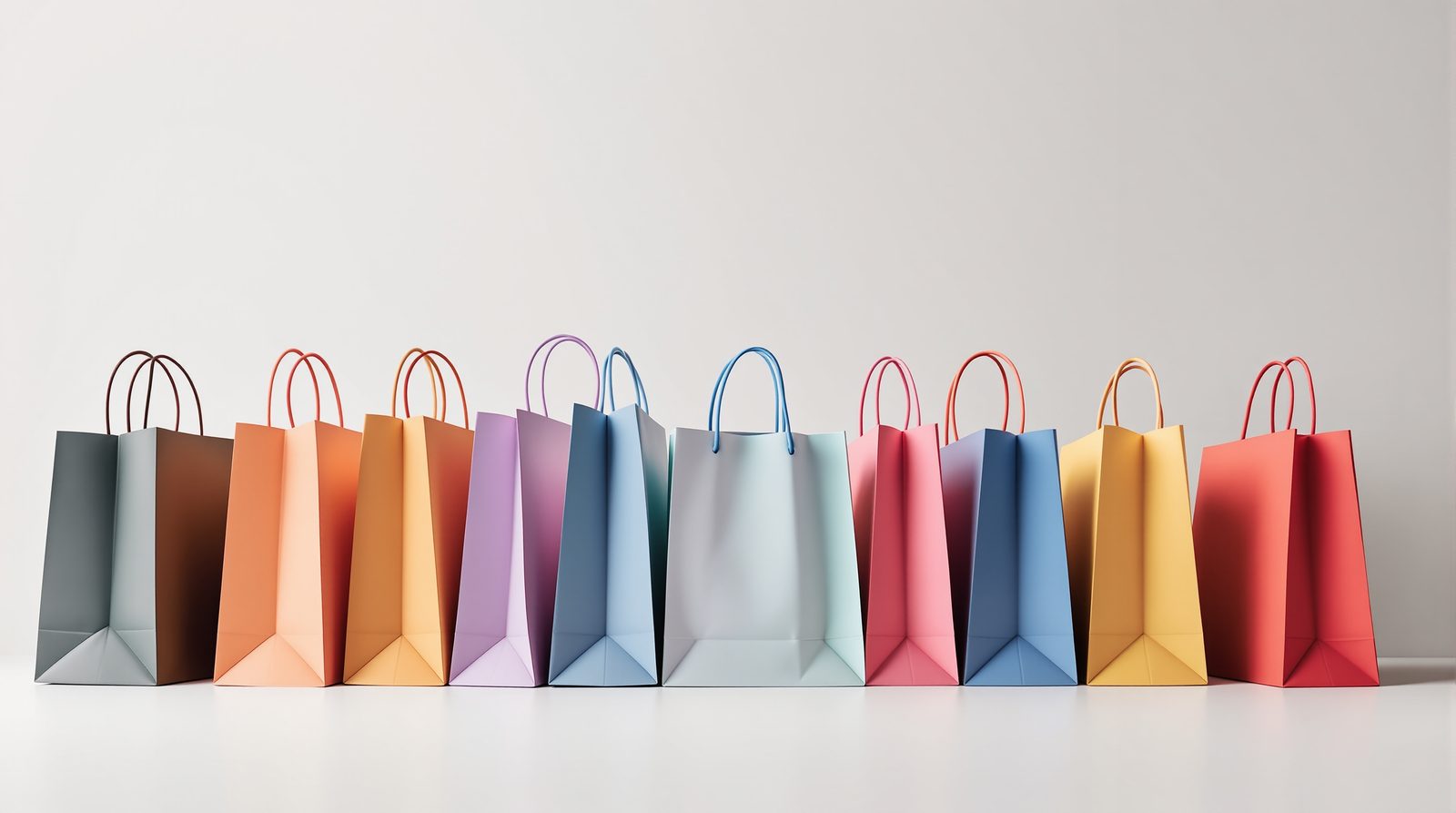
Handle choice follows both load and look — rope and cord where the bag needs to read premium and carry weight through reinforced eyelets, and the more economical die-cut and twisted paper styles where the trip is short and the volume is high.
The gusset gets treated as a visible surface, not a hidden one. Two of these bags are photographed from the gusset for a reason: it is the panel a customer sees while the bag hangs at their side, and artwork that stops at the front panel edge looks unfinished from that angle.
And finish is specified deliberately rather than defaulted into. Several of these clients order a bag and a box against the same brief, which is why our custom gift boxes share stocks and finishing options with the bag work — a matched laminate across both formats is a decision, and so is deliberately not matching them.
Reading Famous Retail Bags the Same Way
The bags most people can picture from memory — Bloomingdale's brown, Tiffany's blue, Selfridges' yellow — are worth studying with the same lens. What they share is not clever design so much as duration. A single color and a stable structure were held constant across years and store counts until the bag itself became the identifier, at which point the logo became almost optional. That kind of durability builds customer loyalty in a way a redesigned bag every season cannot; the brand image compounds instead of resetting, and loyalty of that kind is not something a single custom shopping bags order buys — it accumulates.
That is an observation about consistency, not a promise about outcomes. The transferable lesson is that a bag design earns recognition by staying still, and that redesigning a shopper every season spends the equity the previous one built.
Ordering: Quantity, Minimum Order Quantity, and Custom Bags
None of the programs above started with a fixed quantity in mind. They started with a product, a budget, and a rough sense of how many bags the store or the launch would move, and the order quantity got fixed once the structure and finish were locked. That sequence matters more than the specific minimum order quantity a brand lands on: fix the bag first, then size the order to it, rather than picking a quantity and designing down to fit it.
If you're weighing custom bags for the first time, tell us the product, the rough order size, and the trip the bag has to survive, and we'll tell you plainly what quantity makes sense for your structure and finish before you commit to either. A measurable impact on brand image starts with a bag built for what it actually has to do — not with the biggest order a budget can justify. That holds whether the packaging in question is a short run of paper bags for one retail counter or a multi-format program spanning bags, boxes, and inserts across several store options — the brand behind either one is better served by a size that matches the shelf than by a round number.
Specifying Your Own Bag Program
If you want custom shopping bags that hold up to this kind of scrutiny, the sequence is unglamorous. Fix the structure first — dimensions sized to what you actually sell, gusset depth set by whether you pack boxes or folded goods. Choose the handle against real carried weight, not against a mood board. Then decide what the finish has to accomplish, and be willing to skip it if the answer is "nothing."
Print method follows quantity: digital for short and seasonal runs, screen printing once the volume justifies the setup. And approve a physical prototype in your stock, with your ink, before plates or dies get committed — a laminate, a pearlescent, and a single-ink type mark all read differently in the hand than on a monitor.
Tell us the product, the quantity, and the trip the bag has to survive, and we will spec custom shopping bags against it out of our Manhattan studio. Reach the team at sales@vslpackaging.com or 1.646.843.0800.