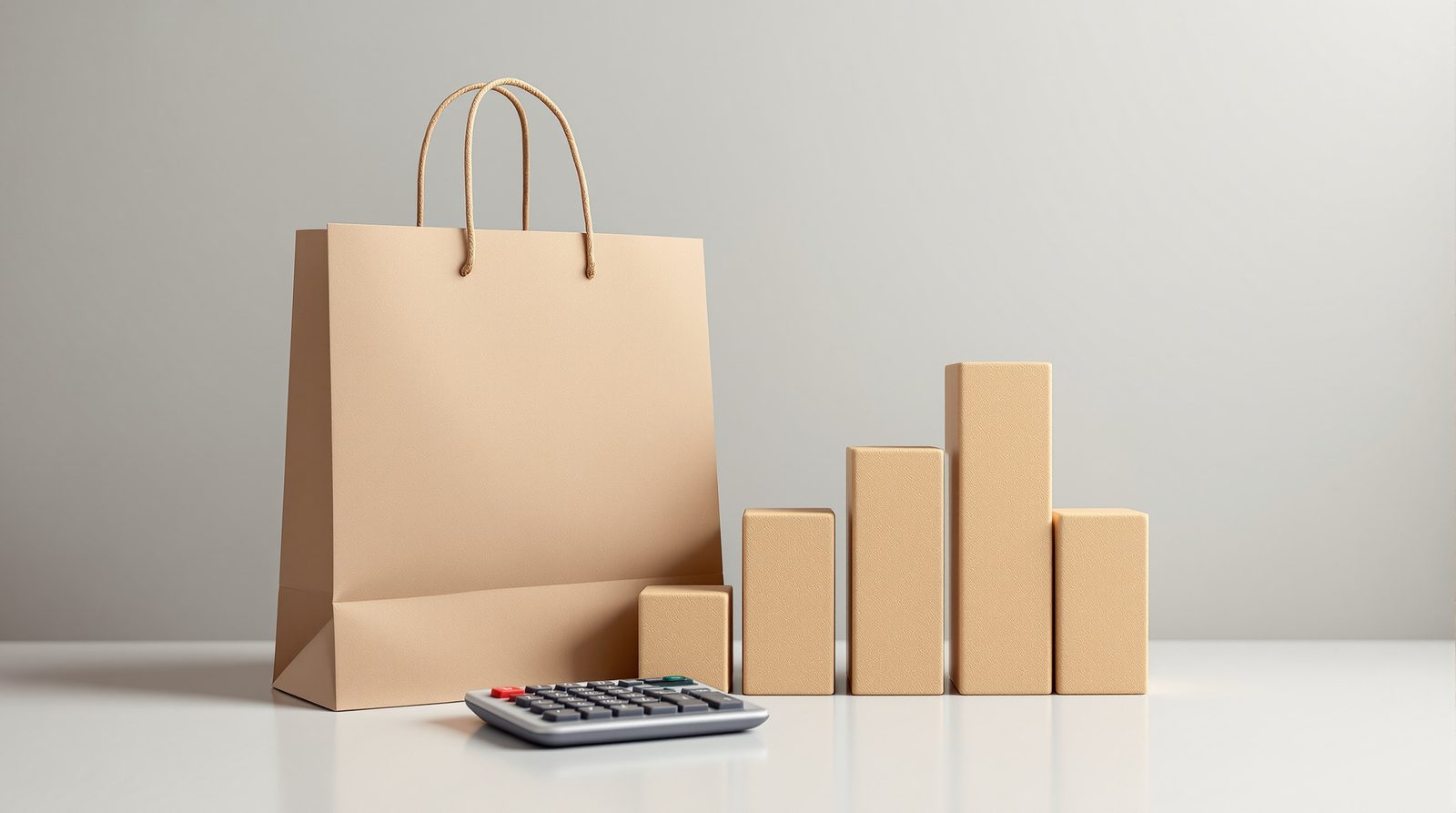
Search "custom shopping bags ROI" and you'll find a lot of confident numbers: bags that return three to five times their cost, brand recall lifts of exactly 40%, impression counts quoted to the thousand. Almost none of it is sourced, and most of it can't be — nobody is running a controlled study on your specific bag, your specific customers, and your specific store. That doesn't mean a custom shopping bag has no measurable value. It means a useful guide looks different from the ones built on invented statistics. The same standard shapes how we talk about custom apparel packaging — we'd rather tell you what we actually know than what sounds persuasive.
Why Most Shopping Bag ROI Numbers Don't Hold Up
A "return on investment" figure requires isolating one variable — the bag — from everything else that happened in the transaction: the product, the price, the season, the salesperson, the storefront. Retail almost never gives you that kind of clean isolation. When you see a specific percentage attached to "brand recall" or "repeat purchases" from custom bags with no methodology attached, the honest response is skepticism, not adoption. A number with no data behind it is marketing copy wearing a lab coat.
That's not a reason to skip measurement. It's a reason to measure only what you can actually observe, and to be plain about what stays a judgment call.
What a Custom Printed Bag Can Actually Do
Set the invented statistics aside and the real case for a custom printed bag over a plain one is straightforward. A branded bag is seen by the customer, by everyone near the customer on the walk home, and by anyone who sees it reused later — a plain, unbranded bag gives none of that back. A well-built bag with a quality stock, reinforced handles, and print that holds up to handling reads as part of the purchase rather than an afterthought, which shapes how customers feel about the product itself, even if that feeling resists being reduced to a single number.
Brand value compounds the same way a retail storefront's signage does: not through one bag's individual impact, but through consistent use across every order, every customer, every trip through the market. Customer loyalty built that way is real but slow, and treating it like a metric you can isolate campaign-by-campaign usually leads straight back to invented numbers.
Pricing a bag run?
Get structure, stock, and finish quoted from your real quantities.
Design Choices That Change What a Bag Communicates
If you're weighing custom retail bags against a plain, off-the-shelf option, the differences customers actually register are structural, not statistical. Paper bags in a heavier stock feel more substantial in the hand than thin plain paper bags, and that difference is felt within the first two seconds of pickup, before a single word of branding registers. Colors carry information too: a brand's established colors on a bag reinforce recognition the same way they do on a storefront or a product label, while a generic palette blends into every other bag on the same block.
Handles matter more than most briefs give them credit for. Reinforced rope or twisted-paper handles on custom paper bags signal quality and survive enough carries to actually get reused, which is the only realistic path to a bag generating more than one impression. A handle that tears after one heavy load ends the bag's useful life at the same moment it ends the customer's patience — whatever a premium print job did for the brand up to that point stops mattering.
Materials follow the same logic. Premium coated stock, lamination, and foil all cost more per unit than plain kraft, and that cost only makes sense against products and purchases where the packaging is genuinely part of what the customer is paying for — a boutique gift purchase, not a hardware run.
Print quality is where a lot of custom printed bags quietly fail. A logo that looks sharp on a screen can print soft, shift color, or lose contrast on an uncoated stock, and a customer registers that mismatch as a quality problem with the brand, not a production detail. Custom retail bags built for a specific market — a Manhattan boutique, a specialty grocer, a wholesale account — should be proofed on the actual stock and in the actual print method before a full run, the same way any other packaging decision gets tested here. A plain, unproofed bag that happens to have a logo on it is not the same thing as a properly specified custom paper bag, even if the two cost about the same per unit.
Print method changes what colors can do. Digital printing handles a short run or a seasonal design without setup cost, and it's forgiving of complex, photographic color work. Screen printing costs more to set up but holds a spot color — a brand's exact red, not the nearest digital approximation — with more consistency across a large retail order, which matters when brand colors are one of the few things a customer registers before they read a single word on the bag. Neither print method is universally better; the right one depends on the quantity, the colors, and how tightly the bag has to match the rest of a brand's materials, from signage to product packaging.
What You Can Actually Measure
Real measurement starts with things a business controls directly, not industry averages. A unique discount code or QR code printed only on the bag — not on receipts, social posts, or in-store signage — tells you how many customers engaged with that specific touchpoint, because nothing else could have generated that code's use. That's your data, generated by your market and your customers, and it holds up to scrutiny in a way a borrowed industry statistic never will.
Simple before-and-after tracking works too: if you switch from a plain bag to a custom one and watch repeat-customer counts or average purchase size over a comparable stretch of time, you have a real (if imperfect) signal, as long as you're honest that other variables — season, pricing, foot traffic — moved at the same time. Customer surveys and direct feedback from staff who hand out the bags every day are blunt instruments, but they're honest ones, and they cost nothing to run.
None of this data has to be sophisticated to be useful. A spreadsheet tracking code redemptions by week, cross-referenced with what else changed in your market that week, will tell you more than a borrowed industry average ever could — because it's your data, from your customers, in your market, not someone else's guess dressed up as a benchmark.
A Framework for Custom Shopping Bags ROI That Doesn't Require Invented Numbers
Think about the bag's return in two parts instead of one blended percentage. The first is direct: what did the bag cost per unit, and what did it replace — a cheaper plain bag, free tissue paper, nothing at all? The second is indirect and genuinely hard to price: the impression the bag makes on the customer holding it and on anyone who sees them carrying it. Custom shopping bags earn their keep on the first part in a way you can put a number on, and on the second part in a way that stays a considered bet rather than a settled return, however many decimal points get attached to it elsewhere.
Custom printed bags work best when that bet is deliberate: a bag built to survive reuse, sized to what you actually sell, and finished to a standard that matches the price point of the products going into it. That is a design decision you can defend on its merits.
Talk to Us About Your Bag Program
We build every custom order against a physical prototype in your stock, your handle, and your ink before it goes to production, so what you approve is what the customer actually receives rather than a rendering. That holds whether your market is a single Manhattan storefront or a wholesale account shipping to stores across the city, and whether the design leans on one brand color or a full-color print. Tell us the product, the purchases it's meant to carry, and how your customers use the bag after checkout, and we'll spec a program against those answers rather than an industry average. You'll find that same standard in our goods packaging work as well.
Ready to talk through your own bag program? Contact VSL Packaging, and we'll start with a prototype instead of a projection.
Related Shopping Bag Articles
More packaging resources: Tuck End Boxes · Seal End Boxes · Straight Tuck End Boxes · Ecommerce Packaging
Upgrade Your Packaging Game!
Looking for custom boxes, bags, mailers, or industry-specific solutions like healthcare, gift, or retail packaging? At VSL Packaging, we create packaging that elevates your brand and protects your product beautifully.
Get a FREE Packaging Consultation with Our Experts Today! Let's turn your packaging needs into powerful brand statements.